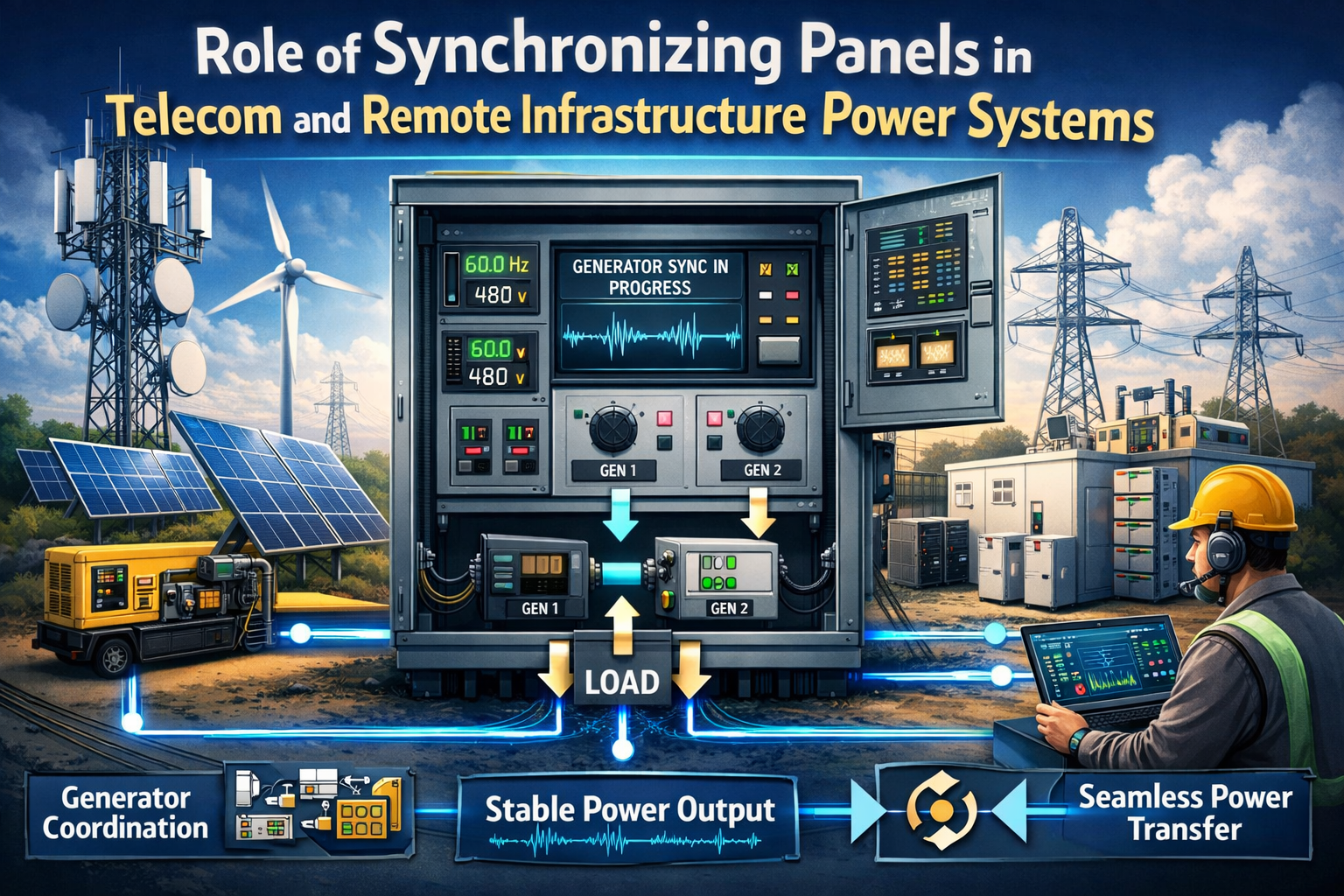
In industrial power systems, generator paralleling is no longer a niche requirement limited to large power plants. Manufacturing facilities, process industries, data centers, and critical infrastructure increasingly rely on multiple generators operating in parallel with each other and with the utility grid. In these environments, the reliability of synchronization is defined not by hardware alone, but by the intelligence of the control system behind it.
This is where a PLC – Based Synchronizing Panel becomes central. Unlike conventional relay-based systems, PLC-driven synchronizing panels offer deterministic logic execution, advanced sequencing capability, and full adaptability to complex operating scenarios. For engineers, the real value lies in how the control logic is designed, validated, and coordinated with generator dynamics.
Why PLC-Based Synchronizing Panels Are Preferred in Industrial Power Systems
Traditional synchronizing relays are effective for basic voltage, frequency, and phase matching, but they are inherently limited in flexibility. Industrial power systems often require conditional logic, multi-mode operation, and interaction with auxiliary systems such as fuel management, load shedding, and process interlocks.
A PLC Based Synchronizing Panel allows synchronization to be treated as a control problem rather than a discrete event. The PLC continuously evaluates system states, generator availability, breaker status, and grid conditions before executing synchronization decisions. This capability is essential when paralleling multiple generators with varying ratings, response characteristics, and operating priorities.
Control Architecture of a PLC-Based Synchronizing Panel
At the core of a PLC-based system is a real-time control loop that monitors electrical parameters and system status. Voltage, frequency, and phase angle are acquired through transducers or digital meters, while breaker status, generator readiness, and fault signals are processed as discrete inputs.
The PLC executes synchronization logic cyclically, ensuring that decisions are based on current system conditions rather than static thresholds. This architecture enables coordinated control across generators, grid incomers, and bus couplers within a single control platform.
Crucially, the PLC does not replace protective relays; instead, it coordinates with them. Protection remains autonomous and fast, while the PLC manages sequencing, permissive logic, and operational control.
Synchronization Logic Design Using PLC
PLC-Based Synchronizing Panel – Pre-Synchronization Logic
Before synchronization, the PLC verifies that the generator is electrically and mechanically ready. This includes confirmation of rated voltage buildup, stable frequency, correct phase rotation, and acceptable governor and AVR response.
Speed and voltage ramping are controlled gradually to avoid overshoot. Unlike relay-based systems that wait passively for alignment, PLC logic actively drives the generator toward synchronism using feedback control. This reduces synchronization time while minimizing transient stress.
PLC-Based Synchronizing Panel – Breaker Closing and Validation Logic
Once synchronization criteria are met within defined tolerances, the PLC issues a breaker close command. However, advanced PLC logic also validates post-closure conditions. It checks for successful breaker operation, confirms that slip frequency collapses as expected, and ensures that no abnormal current or power flow is detected.
If post-synchronization conditions deviate from expected behavior, the PLC can initiate corrective action or controlled disconnection, preventing unstable operation from propagating into the system.
Load Sharing and Post-Synchronization Control
Synchronization is only the first step. In generator paralleling systems, stability depends heavily on how load is shared after connection. PLC-based panels integrate load-sharing algorithms that coordinate governor and AVR references to distribute active and reactive power proportionally.
The PLC continuously monitors real power, reactive power, and frequency deviation to damp oscillations and prevent hunting between generators. This is particularly important in industrial systems with fluctuating loads or large motor starts, where poor load sharing can lead to instability or nuisance tripping.
Handling Multiple Operating Modes
One of the strongest advantages of a PLC Based Synchronizing Panel is its ability to manage multiple operating modes within the same logic framework. These may include island mode operation, grid-parallel operation, generator-only mode, or black-start scenarios.
Each mode requires different synchronization permissives, sequencing rules, and protection coordination. PLC logic enables these modes to coexist without hardware modification, allowing operators to transition between configurations safely and predictably.
Failure Handling and Logic Robustness
In real-world systems, synchronization does not always succeed on the first attempt. Voltage instability, governor lag, or grid disturbances can interrupt the process. PLC-based logic handles these scenarios deterministically by aborting synchronization sequences, resetting conditions, and retrying only when stability is restored.
This approach avoids repeated mechanical stress and uncontrolled breaker operations, which are common failure modes in poorly designed systems.
Engineering Approach of Synchro Electricals
Synchro Electricals designs PLC-based synchronizing panels with a control-engineering-first philosophy. Synchronization logic is developed as a structured sequence with clearly defined states, transitions, and failure responses. Generator dynamics, grid behavior, and operational requirements are modeled into the PLC logic rather than handled as afterthoughts.
This approach ensures that the PLC-based synchronizing panel performs reliably under complex industrial conditions, including multi-generator operation, weak grids, and variable load profiles.
Conclusion
In modern industrial power systems, synchronization is no longer a single moment of alignment but a continuous control function. A PLC-based synchronizing panel provides the intelligence, flexibility, and determinism required to manage generator paralleling safely and efficiently.
By focusing on robust control logic design—covering pre-synchronization, breaker control, load sharing, and failure handling—engineers can build systems that remain stable under real operating stress. PLC-based synchronization is not simply an upgrade in technology; it is a fundamental shift toward system-level power control.
FAQs
[saswp_tiny_multiple_faq headline-0=”h2″ question-0=”1. What differentiates a PLC Based Synchronizing Panel from relay-based systems?” answer-0=”<span style=”font-weight: 400;”>A PLC Based Synchronizing Panel uses deterministic control logic to manage synchronization, sequencing, and load sharing, whereas relay-based systems are limited to threshold-based matching of voltage, frequency, and phase.</span>” image-0=”” fontsize-0=”18″ fontunit-0=”px” headline-1=”h2″ question-1=”2. Can a PLC Based Synchronizing Panel handle multiple generators with different ratings?” answer-1=”<span style=”font-weight: 400;”>Yes. PLC logic can be customized to account for generator capacity, response characteristics, and priority, enabling stable paralleling of unequal machines.</span>” image-1=”” fontsize-1=”18″ fontunit-1=”px” headline-2=”h2″ question-2=”3. How does PLC logic improve synchronization reliability?” answer-2=”<span style=”font-weight: 400;”>PLC logic actively controls speed and voltage ramping, validates post-breaker conditions, and aborts unsafe sequences, reducing transient stress and synchronization failures.</span>” image-2=”” fontsize-2=”18″ fontunit-2=”px” headline-3=”h2″ question-3=”4. Is PLC-based synchronization dependent on protection relays?” answer-3=”<span style=”font-weight: 400;”>Protection relays operate independently for fault clearing. The PLC coordinates operational logic but does not replace protection functions.</span>” image-3=”” fontsize-3=”18″ fontunit-3=”px” headline-4=”h2″ question-4=”5. Can PLC Based Synchronizing Panels support island and grid-parallel operation?” answer-4=”<span style=”font-weight: 400;”>Yes. Multiple operating modes can be implemented within the same PLC program, allowing seamless transitions between islanded and grid-connected states.</span>” image-4=”” fontsize-4=”18″ fontunit-4=”px” count=”5″ html=”true”]